Meet the DHS AI Assistant

At The DHS Program, we care a LOT about data use. The insights and actions building from DHS data can literally save lives.
So, when an opportunity to expand data use presents itself, we jump on it. And we’re jumping—up and down with excitement—to announce the new DHS AI Assistant (MCP)!
This tool is for you.
The DHS AI Assistant gives you easy, reliable, and efficient access to 4,655 indicators indexed from 475 DHS Program surveys (and counting). Connect your AI assistant — Claude, or another MCP-compatible assistant — ask your questions in plain language, and trust that every answer is grounded in authoritative data pulled directly from The DHS Program. You’ll often get key insights and visualizations right alongside the answer. It’s unbelievably simple — and yes, it’s even fun.
We know analyzing data can be hard. The DHS AI Assistant is here to make it easier. Just follow these simple steps to connect, then ask away.
To give you a flavor, here are some questions we were curious about today.
- Among malaria endemic countries, is bed net coverage continuing to expand?
- How has the proportion of zero dose children changed over time in West Africa?
- What biomarkers have been included in surveys since 2020?
- Where is stunting the most prevalent at a national and sub-national level?
- How does contraceptive use vary by subregion in Nigeria?
We got connected and asked Claude. The answers were everything we’d hoped for—straightforward responses grounded in DHS data, with informative charts and maps useful to experts and novices alike. You’ll find one of our exchanges below.
Example:
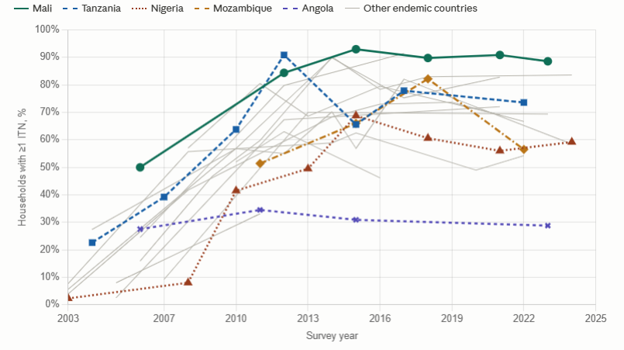
Question: Among malaria endemic countries, is bed net coverage continuing to expand?
Note: Claude’s response is truncated for length. Your answer will be grounded in DHS data like ours, but the specifics may differ — AI assistants don’t return word-for-word identical responses, and how you phrase your question will shape what you get back.
Short answer: the era of rapid expansion is over. What the data show is a steep scale-up that ran from roughly 2005 to the mid-2010s, followed by a plateau, and in a good number of countries outright decline or campaign-driven oscillation rather than continued growth. Here’s household ITN ownership over time, with five countries highlighted to show the distinct trajectories and the rest as gray context.
Interested yet? Bring your own curiosity, jump in, and explore. It’s easier than you think! https://dhsprogram.com/data/DHS-AI-Assistant.cfm